
Thermal Barrier Coating — North Houston & East Texas
Thermal Barrier Coating for Spray Foam Insulation in North Houston & East Texas
Building code requires that spray foam insulation in occupied spaces be covered by a thermal barrier — typically drywall, or an approved intumescent coating when drywall is not practical. Intumescent thermal barrier coatings are applied directly over exposed spray foam, providing the required fire protection while leaving the foam visible in applications like garages, attics, crawl spaces, and commercial facilities where drywall cover is not desired. We apply thermal barrier coatings across North Houston and East Texas.
Get A Free Estimate
What thermal barrier coatings are — and when they are required over spray foam insulation in Texas
Spray polyurethane foam insulation is a combustible material. Building codes in Texas — following the International Building Code and International Residential Code — require that exposed spray foam in occupied or accessible spaces be separated from the interior by an approved thermal barrier. The standard thermal barrier is 1/2-inch drywall. In applications where drywall is not practical — garages, attics, crawl spaces, barndominiums, commercial facilities, and shop buildings — an approved intumescent coating applied over the foam provides the required thermal protection without covering the foam with drywall.
Intumescent coatings work by expanding when exposed to heat. In a fire event, the coating swells to many times its original thickness, forming a char layer that insulates the foam beneath from the heat of the fire. This slows the spread of flame and buys time for occupants to evacuate — which is the purpose of the thermal barrier requirement.
It is important to understand when thermal barrier coatings are required and when they are not. In unoccupied or inaccessible spaces that do not meet code definitions of accessible — some closed attics, some crawl spaces — a thermal barrier may not be required. In occupied spaces, accessible attics, and all commercial applications, it is required. We assess the specific code requirements for your project and advise on whether a thermal barrier coating is needed before we spray foam. For foam already installed without a barrier, we can apply the coating after the fact.

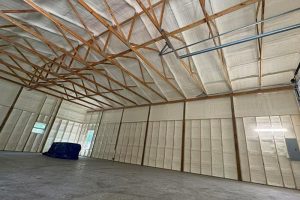
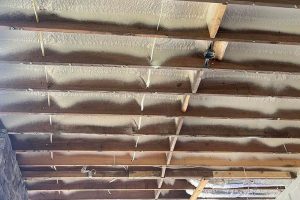
Thermal barrier coating applied on barndominium interior in Coldspring, TX
What thermal barrier coatings do — and what happens without one in an occupied Texas building
Thermal barrier requirements exist for a specific reason — spray foam burns. Understanding what the code requires, when it applies, and what happens when it is ignored protects your project, your occupants, and your investment.
Required for Code Compliance in Occupied Spaces
Spray foam in occupied or accessible spaces without a thermal barrier is a code violation in Texas. Failed inspections, stop-work orders, and required remediation are the practical consequences. Thermal barrier coating applied at the time of foam installation is far less expensive than retrofitting compliance after the fact or after a failed inspection.
Protects the Foam in a Fire Event
Intumescent coatings expand significantly when exposed to heat — forming a dense char layer that dramatically slows heat transfer to the foam beneath. This buys meaningful time in a fire event, slowing the spread of flame from the foam and reducing the speed at which the insulation contributes fuel to the fire.
Leaves the Foam Visible and Accessible
The primary reason thermal barrier coatings are used instead of drywall is that they allow the foam to remain visible — useful in garages, shops, attics, and commercial facilities where drywall would interfere with the use of the space or require significant additional framing. A properly applied coating gives the foam a finished appearance while maintaining code compliance.
Can Be Applied After Foam Installation
If spray foam was installed without a thermal barrier coating and the space now requires one — due to a change in use, a building inspection, or a sale of the property — we can apply the coating over the existing foam. The foam does not need to be removed or replaced. A coating application is a straightforward retrofit solution for previously non-compliant installations.
Required for Commercial Occupancy in Texas
All commercial buildings with exposed spray foam in occupied spaces require an approved thermal barrier. For commercial facilities — warehouses, offices, restaurants, shops — the thermal barrier requirement applies universally. Intumescent coating is the practical solution for commercial spaces where drywall cover would be impractical or aesthetically unacceptable.
Part of a Complete Spray Foam System
A correctly specified spray foam installation in an occupied or accessible space includes both the foam and the thermal barrier as part of a single, compliant system. We include thermal barrier coating in our scope on all applicable jobs — it is not an afterthought or an add-on, but a required part of the installation.
Thermal barrier coating vs. drywall vs. no barrier — what Texas building code requires
Building code allows multiple approaches to satisfying the thermal barrier requirement over spray foam. Here is how the options compare for common applications in North Houston and East Texas buildings.
| Intumescent Coating | Drywall Cover | No Barrier | |
|---|---|---|---|
| Meets code in occupied spaces | Yes | Yes | No — violation |
| Foam remains visible | Yes | No | Yes |
| Works in garages and shops | Yes | Yes | No |
| Can be retrofitted | Yes | Yes | N/A |
| Additional framing required | No | Sometimes | No |
| Practical for commercial | Yes | Depends | No |
| Installation cost | Lower | Higher | None — but non-compliant |
Thermal barrier coating applications across North Houston & East Texas
Thermal barrier coating is required wherever spray foam is exposed in occupied or accessible spaces. Here are the common applications where we apply intumescent coating as part of a complete spray foam installation across North Houston and East Texas.
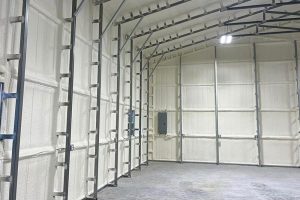
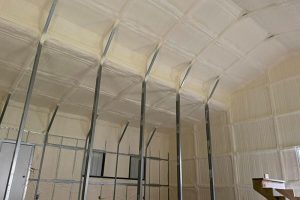
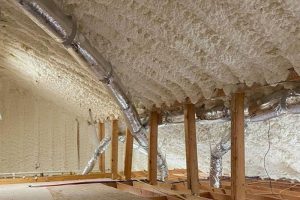
All commercial buildings with spray foam in occupied spaces require an approved thermal barrier. For large commercial warehouses and facilities, intumescent coating is almost always the practical choice over drywall — it covers large areas efficiently and does not require the framing and finishing that drywall demands in high-bay commercial environments.

Recent thermal barrier coating projects in North Houston & East Texas
Thermal barrier coating applications across the region — pulled directly from our project archive. Every job is linked to the full project page with photos, building type, and location details.
Sorry, we couldn't find any posts. Please try a different search.
Why North Houston property owners choose Weeks Spray Foam for thermal barrier coatings
Thermal barrier coatings are most effective when they are specified and applied by the same contractor who installed the spray foam — because the code compliance of the full system depends on both components being correctly installed. We include thermal barrier coating in our scope on all applicable jobs, and we handle retrofit coating applications for existing foam that was installed without a barrier.
Licensed & Insured Spray Foam Contractor
Fully licensed for spray foam and thermal barrier coating applications throughout Texas.
We Know the Code Requirements
Thermal barrier requirements vary by space type, occupancy, and code edition. We know the requirements applicable to your specific project and advise before we spray.
Free Estimates, No Pressure
We assess your project, determine whether a thermal barrier is required, and include it in your written estimate before any work begins.
100+ Five-Star Reviews
Trusted by homeowners, business owners, and builders across North Houston and East Texas for spray foam and code compliance work.
What customers say about working with Weeks Spray Foam
EXCELLENTTrustindex verifies that the original source of the review is Google. They did a great job good price . Thank youPosted on GoogleTrustindex verifies that the original source of the review is Google. Austin and his crew did a great job on our little barndo guest house! We will definitely use them for future projects.Posted on GoogleTrustindex verifies that the original source of the review is Google. Hands down best in town! Very responsive, great price and great and quick work I would call them and refer my friends!Posted on GoogleTrustindex verifies that the original source of the review is Google. Great work, would recommendPosted on GoogleTrustindex verifies that the original source of the review is Google. Did a great job insulating an add on at our Church "Hillister Assembly of God". I would definitely recommend them.Posted on GoogleTrustindex verifies that the original source of the review is Google. I can’t say enough great things about Weeks Spray Foam! From the very first phone call to the final walkthrough, their team was professional, knowledgeable, and genuinely committed to doing the job right. They took the time to explain the entire process, answered all of my questions, and made sure I felt confident every step of the way. The quality of their work is outstanding — clean, precise, and completed on schedule. You can tell they take real pride in what they do. On top of that, their customer service is second to none. Friendly, responsive, and reliable — exactly what you hope for when hiring a contractor. If you’re looking for spray foam insulation done right, I highly recommend Weeks Spray Foam. You won’t be disappointed!Posted on GoogleTrustindex verifies that the original source of the review is Google. We absolutely love these guys! They spray all of our new builds great customer service short lead times and fast quality workPosted on GoogleTrustindex verifies that the original source of the review is Google. After being screwed around by another spray foam company, I reached out to Weeks and BOOM, 100% professional service, great quality of work and clean up, along with best in class customer service and price! Will certainly have them out again, for my next project!
A straightforward way to get the job done
Thermal barrier coating is typically applied as part of a complete spray foam installation. For retrofit applications on existing foam, we assess the existing installation, confirm the code requirements, and apply the coating in a single visit.
-
Request a Quote
Tell us about the building, the project type, and where the property is located. -
Review the Job
We look at the scope, building type, and insulation needs so we can recommend the right solution. -
Schedule the Work
We coordinate timing and keep the project moving as efficiently as possible. -
Install the Spray Foam
Our crew completes the work with a focus on quality, consistency, and long-term performance. -
Enjoy a Better-Performing Building
You get a tighter, more comfortable, more energy-efficient space built for Texas conditions.
How much does thermal barrier coating cost in North Houston?
Thermal barrier coating typically runs $0.25–$0.75 per square foot of coated surface depending on the product, surface geometry, and coverage requirements. For most residential applications — a garage, attic, or crawl space — the coating cost is a small fraction of the total spray foam installation cost. For large commercial applications, we price per square foot based on the specific product and project scope. We provide a firm written estimate for every job.
Square footage of exposed foam surface
New installation vs. retrofit on existing foam
Residential vs. commercial occupancy
Space type and code requirements
Surface geometry and accessibility
Product type and required dry film thickness
Thermal barrier coating service areas — North Houston, East Texas & the Lake Livingston region
We apply thermal barrier coatings throughout North Houston and East Texas. Not sure if we cover your area? Call us at (936) 433-7046.
Thermal barrier coating FAQs — code requirements, cost & Texas applications
Does all spray foam require a thermal barrier coating in Texas?
No — the requirement depends on whether the space is defined as occupied or accessible under the applicable building code. Spray foam in a fully enclosed, inaccessible cavity — such as a closed wall cavity covered by drywall, or a crawl space with no access hatch — does not require a separate thermal barrier because the drywall or other finish material serves that function. Spray foam that is exposed in an accessible or occupied space — such as a garage, accessible attic, shop, or commercial facility — requires an approved thermal barrier. We assess the specific code requirements for your project before we spray.
Can I use drywall instead of thermal barrier coating?
Yes — drywall is the most common thermal barrier over spray foam in residential construction. Half-inch gypsum drywall satisfies the thermal barrier requirement in most residential applications. Thermal barrier coatings are used in applications where drywall is not practical — garages, barndominiums, commercial warehouses, attic rooflines with complex geometry, and other spaces where installing and finishing drywall would be impractical or undesirable.
What happens if spray foam is installed without a thermal barrier in an occupied space?
Exposed spray foam in an occupied space without a thermal barrier is a code violation. Practical consequences include failed building inspections, stop-work orders, required remediation before certificate of occupancy is issued, and potential issues with property insurance and sale. For existing properties with non-compliant exposed foam, intumescent coating is the most practical remediation solution — it can be applied over existing foam without requiring removal.
How is thermal barrier coating applied?
Intumescent thermal barrier coating is applied by spray over the cured spray foam surface. The coating is typically applied in one or two coats to achieve the required dry film thickness specified by the product manufacturer and confirmed for the code application. Surface preparation is minimal — the foam must be clean and free of dust. We apply the coating using the same type of equipment used for industrial coatings, and the process is typically completed in the same visit as the foam installation for new projects.
How long does thermal barrier coating last?
Properly applied intumescent coatings last for the life of the spray foam installation in normal building environments — 20 to 30+ years. They do not require maintenance in enclosed building applications. In environments with significant UV exposure, abrasion, or chemical exposure, the coating lifespan may be shorter and periodic inspection or reapplication may be warranted. For typical residential and commercial building environments in North Houston and East Texas, one application is a permanent solution.
How much does thermal barrier coating cost in North Houston?
Thermal barrier coating typically runs $0.25–$0.75 per square foot depending on the product and coverage requirements. For most residential applications, the coating cost is a relatively small addition to the spray foam installation cost. For commercial applications, we price per square foot based on the specific scope. We include thermal barrier coating in our written estimate for all applicable jobs. Call (936) 433-7046 or fill out the form above to get started.