
Commercial Spray Foam Insulation — North Houston & East Texas
Commercial Spray Foam Insulation for North Houston & East Texas Buildings
Warehouses, manufacturing facilities, office buildings, and agricultural structures require insulation that meets code, performs in Texas heat, and gets installed on a schedule that doesn’t shut down your operation.
Get A Free Estimate
What commercial spray foam insulation involves — and why it's different from residential
Commercial insulation jobs are larger, more schedule-dependent, and held to stricter code requirements than residential work. The consequences of a failed system — condensation in a food-service facility, moisture infiltration in a warehouse, under-insulated HVAC in a server room — are far more costly than a drafty bedroom.
Weeks Spray Foam works directly with commercial property owners, general contractors, and construction managers throughout North Houston and East Texas. We provide written estimates with documented R-value targets and application thickness, coordinate with your GC’s schedule to avoid shutting down operations, and produce completion documentation for inspectors and owner representatives when required.
Every commercial job gets the same product quality and crew accountability as our residential work — at larger scale, with the documentation requirements commercial projects demand.

Workshop Insulation in Conroe, TX
Six reasons commercial property owners choose spray foam over conventional insulation systems
Commercial buildings in North Houston and East Texas face humidity, heat loads, and energy code requirements that conventional insulation systems routinely fail to handle. Closed-cell spray foam solves the problems fiberglass and rigid board leave behind — condensation, air leakage, layered assemblies, and documentation gaps. Here’s why commercial property owners in Climate Zone 2 are making the switch.
Meets IECC Commercial Energy Code
Closed-cell spray foam at the correct thickness meets International Energy Conservation Code requirements for Climate Zone 2 — North Houston and East Texas. We document the R-value and thickness on every commercial job.
Eliminates Condensation in Metal Structures
In Texas climate zone 2, condensation in uninsulated or improperly insulated commercial metal buildings is a near-certainty. Closed-cell foam bonded to the metal skin eliminates it entirely — protecting inventory, equipment, and the structure itself.
Reduces Operating HVAC Costs
A properly air-sealed commercial building dramatically reduces HVAC load. Warehouses that were impossible to cool in summer become manageable. Office buildings maintain consistent temperature without the hot and cold zones that drive energy waste.
One Install for Air Barrier, Vapor Barrier, and Insulation
Fiberglass and rigid board assemblies require separate air barrier and vapor retarder products. Closed-cell spray foam provides all three in a single application — reducing installation time and eliminating the gaps and seams that separate products leave.
Minimal Operational Disruption
We schedule commercial installs around your operational hours — evenings, weekends, phased by building section. Ventilation requirements after application are typically two to four hours. We coordinate the timeline before we book.
Documentation for GCs and Inspectors
We provide written completion documentation confirming applied thickness and R-value achieved for every commercial project. If your GC, owner's rep, or building inspector needs it, we have it.
Commercial spray foam vs. fiberglass vs. rigid board — what meets code and holds up in Texas
GCs in North Houston and East Texas typically spec fiberglass batt or rigid foam board for commercial projects because they’re familiar products. Here is how those stack up against closed-cell spray foam on the criteria that actually matter in commercial construction.
| Feature | Closed-Cell Spray Foam | Fiberglass / Mineral Wool Batt | Rigid Foam Board |
|---|---|---|---|
| R-value per inch | R-6 to R-7 | R-3.2 to R-4.2 | R-3.8 to R-6.5 |
| Continuous air barrier | Yes — monolithic | No | Partial — seams leak |
| Class II vapor retarder | Yes | No | Varies by product |
| Stops condensation on metal | Yes — bonds to metal | No | No — gap at seams |
| Adds structural rigidity | Yes | No | No |
| Meets IECC commercial code | Yes at correct thickness | Yes — requires more depth | Yes at correct thickness |
| Inspector-ready documentation | Yes — we provide it | Product data sheet only | Product data sheet only |
Want more detail? → Is spray foam worth it in Texas? · Open-cell vs. closed-cell — full breakdown
Commercial building types we insulate with spray foam across North Houston and East Texas
Commercial spray foam projects vary significantly by building type, occupancy, and use. Here is how we approach the most common commercial structures in the North Houston and East Texas market.
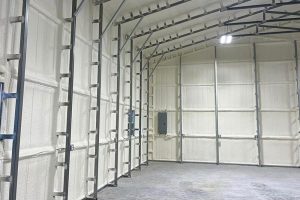
Warehouses and distribution centers
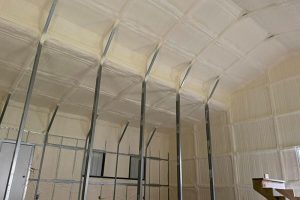
Office buildings and commercial suites
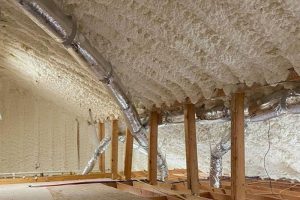
Manufacturing and industrial facilities
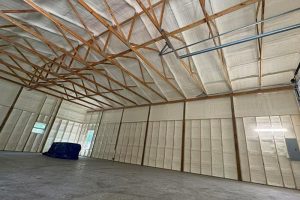
Cold storage and climate-controlled spaces
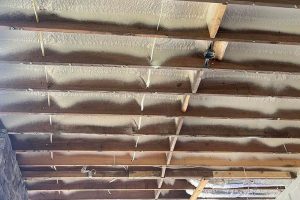
Agricultural and equestrian facilities

Retail and food-service buildings
Recent open-cell spray foam projects in North Houston & East Texas
Real installs across the region — pulled directly from our project archive by service type. Every job linked to the full project page with photos and details.
Sorry, we couldn't find any posts. Please try a different search.
Why commercial property owners and GCs in North Houston choose Weeks Spray Foam
Commercial spray foam requires more than equipment and product. It requires scheduling discipline, GC coordination, documentation, and a crew that understands commercial code requirements. Weeks Spray Foam has completed commercial insulation projects across North Houston and East Texas — warehouses, office builds, agricultural facilities, and specialty cold storage applications.
Written Specs and Completion Documentation
We provide written estimates with R-value targets and application thickness. On request, we produce completion documentation for GCs, owner's reps, and building inspectors — confirming applied thickness and product specs.
Licensed & Insured for Commercial Work
Fully licensed and carrying proper commercial project insurance. Every job is insured before we start.
Schedule Around Your Operations
We work evenings, weekends, and phased by building section when needed. Commercial projects don't have to disrupt your operation — coordinate the timeline with us during the estimate.
100+ Five-Star Reviews
Trusted by commercial property owners, GCs, and builders across North Houston and East Texas.
What commercial clients say about Weeks Spray Foam
EXCELLENT Based on 124 reviews
 Posted on Google
 Jimmie JonesThey did a great job good price . Thank youPosted on Google
 Steven StruthersAustin and his crew did a great job on our little barndo guest house! We will definitely use them for future projects.Posted on Google
 Adys MirabalHands down best in town! Very responsive, great price and great and quick work I would call them and refer my friends!Posted on Google
 John BenckensteinGreat work, would recommendPosted on Google
 EddieDid a great job insulating an add on at our Church "Hillister Assembly of God". I would definitely recommend them.Posted on Google
 Jennifer WellsI can’t say enough great things about Weeks Spray Foam! From the very first phone call to the final walkthrough, their team was professional, knowledgeable, and genuinely committed to doing the job right. They took the time to explain the entire process, answered all of my questions, and made sure I felt confident every step of the way. The quality of their work is outstanding — clean, precise, and completed on schedule. You can tell they take real pride in what they do. On top of that, their customer service is second to none. Friendly, responsive, and reliable — exactly what you hope for when hiring a contractor. If you’re looking for spray foam insulation done right, I highly recommend Weeks Spray Foam. You won’t be disappointed!Posted on Google
 bowman reynoldsWe absolutely love these guys! They spray all of our new builds great customer service short lead times and fast quality workPosted on Google
 Josh FulcherAfter being screwed around by another spray foam company, I reached out to Weeks and BOOM, 100% professional service, great quality of work and clean up, along with best in class customer service and price! Will certainly have them out again, for my next project!
A straightforward way to get the job done
Commercial jobs are scoped with a site visit and a written estimate before any work is scheduled. We confirm scheduling, ventilation requirements, and access coordination with your team before we mobilize.
-
Request a Quote
Tell us about the building, the project type, and where the property is located. -
Review the Job
We look at the scope, building type, and insulation needs so we can recommend the right solution. -
Schedule the Work
We coordinate timing and keep the project moving as efficiently as possible. -
Install the Spray Foam
Our crew completes the work with a focus on quality, consistency, and long-term performance. -
Enjoy a Better-Performing Building
You get a tighter, more comfortable, more energy-efficient space built for Texas conditions.
How much does commercial spray foam insulation cost in North Houston?
Commercial closed-cell spray foam typically runs $1.25–$3.00 per board foot depending on application, required thickness, and building access. A 10,000 sq ft warehouse insulated at the roof deck and upper walls typically falls in the $18,000–$35,000 range. Cold storage, specialty assemblies, and high-access jobs run higher. We provide a written estimate with documented specs for every commercial project — not a range from a phone call.
Building square footage and type
Required R-value per IECC code
Roofline only vs. full envelope
New construction vs. retrofit
Phased installation vs. single mobilization
Documentation requirements (GC, inspector, owner's rep)
Commercial spray foam service areas — North Houston, East Texas & the Lake Livingston region
We serve commercial clients throughout North Houston and East Texas — including Houston, Conroe, Huntsville, Livingston, Cleveland, Liberty, Lufkin, and surrounding communities. Large commercial projects considered outside the standard service area on a case-by-case basis. Call (936) 433-7046.
Commercial spray foam FAQs — specs, code, scheduling & North Houston projects
Does commercial spray foam meet Texas building code?
Closed-cell spray foam applied at the correct thickness meets IECC commercial energy code requirements for Climate Zone 2, which covers the North Houston and East Texas region. We document R-values and application thickness on every commercial job. If your project requires code documentation for a GC or inspector, we provide it as part of the job completion package.
Can spray foam be installed while a commercial building is occupied?
It depends on the space. Spray foam application requires ventilation and area clearance during and for approximately two to four hours after application. For occupied facilities, we schedule installs outside business hours, by building phase, or during planned shutdowns. We discuss the operational impact in detail during the estimate and plan the schedule around your constraints.
What documentation do you provide for commercial spray foam jobs?
We provide written estimates with R-value targets and specified application thickness. On request, we produce completion documentation confirming applied thickness and product specifications — formatted for GCs, owner's representatives, and building inspectors. Ask about documentation requirements at the estimate stage.
Do I need a thermal barrier over spray foam in a commercial building?
In occupied commercial spaces, Texas building code and IECC require spray foam to be covered by a thermal barrier — typically 1/2-inch Type X drywall. In non-occupied commercial spaces — mechanical rooms, plenum spaces, unconditioned storage — requirements vary by occupancy classification. We spec the correct assembly for each area and advise accordingly.
How long does a commercial spray foam installation take?
Single-story 10,000 sq ft warehouses typically take one to two days. Larger structures, multi-zone buildings, and jobs with access constraints run three to five days. We build a project timeline into the written estimate so you can plan your operation around the install.