
Attic Spray Foam Insulation
Attic Spray Foam Insulation in North Houston & East Texas — Stop the Heat at the Source
In Texas, your attic isn’t storage space — it’s the biggest source of heat gain in your home. Spray foam at the roofline eliminates the 150°F attic and brings your HVAC equipment into conditioned space where it can actually perform.
Get A Free Estimate
What's really happening in your attic — and why adding more blown-in doesn't fix it
On a summer afternoon in North Houston, your attic reaches 140–160°F. Every duct running through that space is losing conditioned air through seam leaks and gaining heat through the duct wall before it ever reaches your living space. Every air handler sitting in that attic is operating in conditions that cut its efficiency in half.
Adding blown-in insulation to the attic floor is the conventional response to this. It increases the R-value between the living space and the attic — but it does nothing about the 150°F attic itself. Your HVAC is still in that oven. Your ducts are still in that oven. The radiant heat is still pressing down on the ceiling below.
Spray foam at the roofline changes the equation entirely. Instead of insulating below the attic, you insulate the roof deck — turning the attic into conditioned space that stays within 10–15°F of your living area. HVAC operates at rated efficiency. Ducts stop losing conditioned air to an extreme temperature differential. The ceiling below sees dramatically lower radiant heat. The result is a measurable, lasting reduction in cooling costs.

Attic spray foam insulation in Insulation in Huntsville, TX
Six benefits of spray foam at the roofline for North Houston and East Texas homes
In North Houston and East Texas, an uninsulated attic routinely hits 150°F in summer — and your HVAC ducts, air handler, and ceiling are absorbing all of it. Spray foam at the roofline brings the attic inside the conditioned envelope, eliminating the heat source that drives most of your energy loss. Here’s what changes when the attic stops working against you.
HVAC Operates in Conditioned Space
An air handler and ductwork inside a conditioned attic operate at rated efficiency instead of fighting a 150°F environment. This single change can recover 15–25% of HVAC capacity you're currently losing to attic heat.
Radiant Heat Load on Ceiling Is Eliminated
The ceiling below an uninsulated attic is absorbing radiant heat all day in Texas summer. With the attic conditioned, that ceiling is no longer sandwiched between conditioned living space below and an oven above.
Duct Losses Are Dramatically Reduced
Conditioned air in ducts running through a 150°F attic gains heat before it reaches the supply register. In a conditioned attic, the temperature differential between duct interior and attic air drops from 120°F to near zero — eliminating duct gain entirely.
Works for New Construction and Existing Homes
Roofline foam is one of the few high-performance upgrades that works equally well as a new construction spec and as a retrofit on an existing home — because it's applied to the underside of the existing roof deck and doesn't require any demolition.
Creates Dry, Stable Storage Space
A conditioned attic stays dry and near living temperature year-round. What was previously unusable dead space becomes legitimate dry storage that doesn't destroy what you put in it.
Compatible with Standard Roofing Materials
Spray foam at the roofline is applied to the underside of the roof sheathing from inside the attic — it has no interaction with your shingles or roofing surface. Roofing repairs and replacements are handled identically on a foamed roofline as on an uninsulated one.
Roofline spray foam vs. blown-in vs. radiant barrier — what actually solves the Texas attic problem
These are the three products most frequently pitched to North Houston and East Texas homeowners as attic insulation solutions. Here is how they compare on what actually matters in a hot attic.
| Feature | Roofline Spray Foam | Blown-In (Attic Floor) | Radiant Barrier |
|---|---|---|---|
| Creates conditioned attic | Yes | No | No |
| Protects HVAC in attic | Yes — HVAC in conditioned space | No — HVAC still in extreme heat | Partially reduces heat |
| Eliminates duct heat gain | Yes | No | No |
| Air seals ceiling plane | Yes | No — requires separate sealing | No |
| Reduces peak attic temperature | Dramatically — near living temp | None — attic still 140–160°F | Moderate — reduces radiant only |
| Settles or loses effectiveness | No — permanent | Yes — settles 10–20% over years | Yes — reduces as dust accumulates |
| Works as retrofit (no demolition) | Yes | Yes | Yes |
Want more detail? → Is spray foam worth it in Texas? · Open-cell vs. closed-cell — full breakdown
Which attic insulation approach is right for your home?
There are two distinct approaches to attic insulation with spray foam — and the right one depends on what’s in your attic. Here is how to determine which applies to your situation.
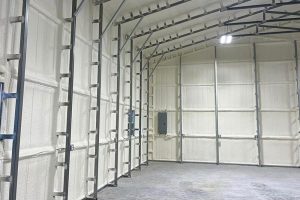
Roofline application — if you have HVAC in the attic
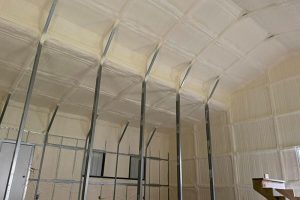
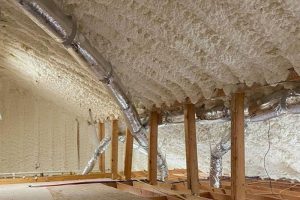
Gable walls and knee walls
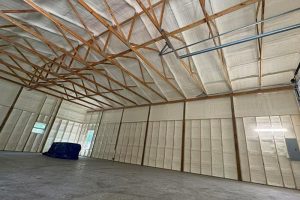
Attic hatches and access panels
Attic Spray Foam Insulation in North Houston & East Texas — Stop the Heat at the Source
Most North Houston and East Texas homes have their HVAC equipment sitting in an attic that hits 150°F all summer. Adding blown-in insulation to the attic floor raises your R-value — but leaves your air handler and ducts in an oven. Spray foam at the roofline turns the attic into conditioned space, where your HVAC can actually perform.
Sorry, we couldn't find any posts. Please try a different search.
Why North Houston and East Texas homeowners choose Weeks for attic spray foam
Attic foam is frequently done wrong — the most common errors are applying foam only at the attic floor when HVAC is present, leaving gable walls unfoamed, and under-applying thickness on the roof deck. These mistakes don’t show up in appearance but they show up in the energy bill. Weeks assesses what’s in your attic first, recommends the correct approach, and installs at the right thickness.
We Diagnose First
Before we quote anything, we assess what's in your attic — HVAC location, duct configuration, existing insulation, and roofline geometry. The diagnosis determines the correct approach. We won't sell you roofline foam if attic floor is what you need, or vice versa.
Licensed & Insured
Spray Foam Contractor Fully licensed for attic spray foam applications throughout Texas.
Correct Thickness, Documented
Attic roofline foam at under 3 inches doesn't achieve unvented assembly performance. We apply at the correct thickness and confirm it before leaving.
100+ Five-Star Reviews
Trusted by homeowners across North Houston and East Texas — many of whom came to us after a disappointing result from another contractor.
What North Houston homeowners say about our attic spray foam installations
EXCELLENT Based on 124 reviews
 Posted on Google
 Jimmie JonesThey did a great job good price . Thank youPosted on Google
 Steven StruthersAustin and his crew did a great job on our little barndo guest house! We will definitely use them for future projects.Posted on Google
 Adys MirabalHands down best in town! Very responsive, great price and great and quick work I would call them and refer my friends!Posted on Google
 John BenckensteinGreat work, would recommendPosted on Google
 EddieDid a great job insulating an add on at our Church "Hillister Assembly of God". I would definitely recommend them.Posted on Google
 Jennifer WellsI can’t say enough great things about Weeks Spray Foam! From the very first phone call to the final walkthrough, their team was professional, knowledgeable, and genuinely committed to doing the job right. They took the time to explain the entire process, answered all of my questions, and made sure I felt confident every step of the way. The quality of their work is outstanding — clean, precise, and completed on schedule. You can tell they take real pride in what they do. On top of that, their customer service is second to none. Friendly, responsive, and reliable — exactly what you hope for when hiring a contractor. If you’re looking for spray foam insulation done right, I highly recommend Weeks Spray Foam. You won’t be disappointed!Posted on Google
 bowman reynoldsWe absolutely love these guys! They spray all of our new builds great customer service short lead times and fast quality workPosted on Google
 Josh FulcherAfter being screwed around by another spray foam company, I reached out to Weeks and BOOM, 100% professional service, great quality of work and clean up, along with best in class customer service and price! Will certainly have them out again, for my next project!
A straightforward way to get the job done
Attic spray foam starts with an attic assessment — we look at what’s there before we scope anything. For roofline installations, existing attic floor insulation stays in place. The install is typically completed in a single day.
-
Request a Quote
Tell us about the building, the project type, and where the property is located. -
Review the Job
We look at the scope, building type, and insulation needs so we can recommend the right solution. -
Schedule the Work
We coordinate timing and keep the project moving as efficiently as possible. -
Install the Spray Foam
Our crew completes the work with a focus on quality, consistency, and long-term performance. -
Enjoy a Better-Performing Building
You get a tighter, more comfortable, more energy-efficient space built for Texas conditions.
How much does attic spray foam insulation cost in North Houston?
Roofline spray foam typically runs $1.50–$3.00 per board foot. A standard 2,000 sq ft home with a moderately complex roofline typically falls in the $4,500–$9,000 range for a roofline installation. Simpler rooflines come in lower. Attic floor application (at top plates and ceiling plane) is typically less expensive than roofline work. We assess your specific attic and give you a firm number.
Roofline vs. attic floor application
Attic square footage
Roofline complexity and access
HVAC location and duct configuration
Existing insulation condition
Gable wall inclusion
Attic spray foam service areas — North Houston, East Texas & the Lake Livingston region
We install attic spray foam throughout North Houston and East Texas. Most jobs are completed in a single day with no disruption to the living space below. Not sure if we cover your area? Call (936) 433-7046.
Attic spray foam FAQs — roofline, conditioned attic & Texas homes
Should I put spray foam at the roofline or on the attic floor?
If your air handler or any ductwork is in the attic — roofline. Insulating the floor while your HVAC is in an unconditioned 150°F attic is addressing the wrong surface. The attic is the problem; insulating the ceiling below it doesn't solve the attic. If your attic has no HVAC equipment at all, attic floor application may be appropriate.
Will roofline spray foam affect my roof warranty or ventilation?
Roofline foam creates an unvented attic assembly, which eliminates the need for soffit and ridge vents. This is an established, code-recognized building assembly under IRC Section R806.5. It is not a roof modification — foam is applied to the underside of the sheathing from inside. Your roofing material and warranty are unaffected.
Do I have to remove existing attic insulation before adding spray foam?
For roofline application — no. We spray the foam onto the underside of the roof deck; the existing attic floor insulation stays in place. For attic floor application targeting the top plates and ceiling plane, we may need to move existing insulation to access the areas being sealed.
How much will roofline foam reduce my cooling costs?
Homeowners with HVAC in the attic commonly see 20–35% reductions in summer cooling costs after roofline foam installation. The gains come from two sources: moving HVAC equipment into conditioned space and eliminating the radiant heat load on the ceiling below. We can give you a more specific expectation during the estimate based on your home's existing conditions.
Can I still access my attic after spray foam is installed?
Yes — roofline foam is applied to the roof deck and gable walls. The attic floor remains fully accessible. Storage, HVAC service access, and inspections all proceed normally.