
Open-Cell Spray Foam Insulation
Open-Cell Spray Foam Insulation for North Houston & East Texas Homes
Open-cell spray foam fills every cavity completely, controls sound between rooms, and creates a real air seal — at roughly half the cost of closed-cell. It’s the right product for interior walls, attic rooflines, and buildings where moisture isn’t the primary concern.
Get A Free Estimate
What is open-cell spray foam — and how is it different from closed-cell?
Open-cell spray foam is a soft, flexible polyurethane insulation that expands aggressively when applied — up to 100 times its liquid volume. Unlike closed-cell foam, its cells are not fully encapsulated, which gives it a lower density, a softer texture, and an excellent capacity to absorb sound.
It achieves an R-value of approximately R-3.5 to R-3.8 per inch, compared to R-6 to R-7 for closed-cell. That lower R-value per inch doesn’t make it a lesser product — it makes it the right product for different jobs. Interior walls rarely need the same thermal resistance as a metal building roofline. What they need is complete cavity fill, air sealing, and sound control. Open-cell spray foam delivers all three at a cost that makes sense for those applications.
Open-cell foam is also vapor-permeable. In Texas’s climate, that matters for certain assemblies — particularly conditioned attic rooflines where allowing some vapor movement prevents moisture accumulation in the wrong places.
Open-cell is one of two spray foam types we install — see our full Spray Foam Insulation overview to understand how both products fit together.
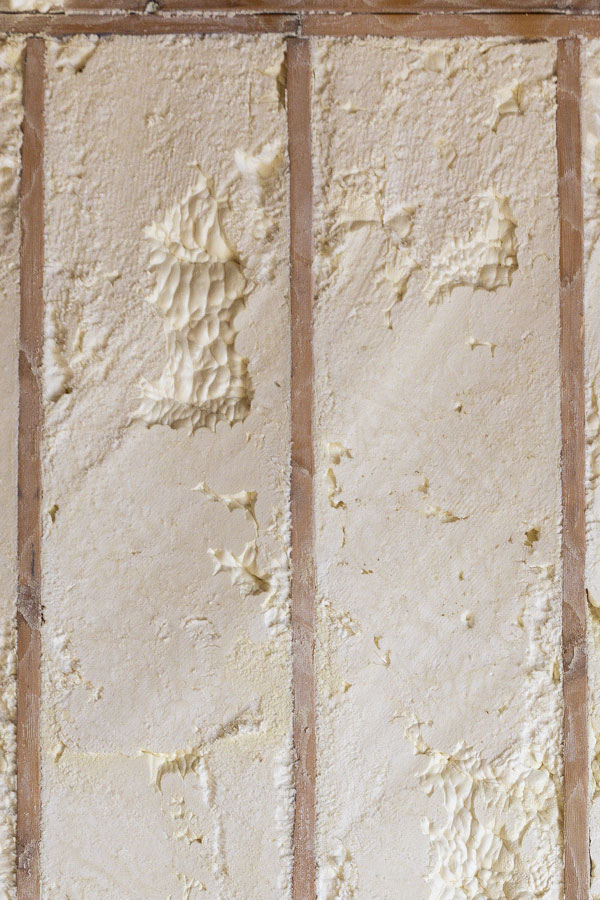
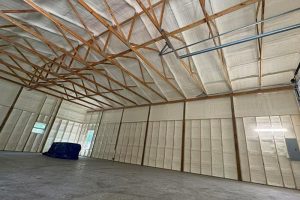
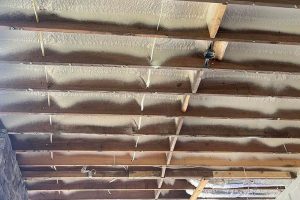
Open-cell spray foam applied to a wood frame building near Livingston, TX
What open-cell spray foam does that fiberglass and batts can't
Complete cavity fill. Real air sealing. Superior sound control. All at a price point that makes sense for interior residential applications across North Houston and East Texas.
Complete Cavity Fill
Unlike fiberglass batts that leave gaps around wires, pipes, and irregular framing, open-cell foam expands to fill every void in a wall or ceiling cavity. No cold spots. No air pathways. No voids.
Real Air Sealing
Insulation and air sealing are two separate things — fiberglass insulates but doesn't seal. Open-cell spray foam does both in a single pass, which is why it consistently outperforms fiberglass on energy efficiency even with a lower R-value per inch.
Sound Dampening
Open-cell's soft, spongy cell structure absorbs sound waves rather than reflecting them. It's widely used in interior walls between rooms, home offices, media rooms, and anywhere noise transmission between spaces matters.
Half the Cost of Closed-Cell
Open-cell uses less raw material per cubic foot and expands more dramatically on application. For interior jobs where closed-cell's structural and moisture-barrier properties aren't needed, it's a significantly more cost-effective solution.
Works Well in Conditioned Attics
Spraying the roofline instead of the attic floor converts the attic into conditioned space — protecting HVAC equipment from extreme Texas heat, keeping ductwork inside the thermal envelope, and cutting cooling loads year-round.
Lasts Without Settling
Open-cell foam doesn't compress, sag, or lose R-value over time the way fiberglass batts do. Properly installed, it performs the same in year 25 as it did in year one.
Open-cell vs. closed-cell vs. fiberglass — which is right for your Texas property?
Open-cell is the right answer for most interior residential applications. See how it stacks up against the alternatives — and where each product earns its place.
| Open-cell | Closed-cell | Fiberglass | |
|---|---|---|---|
| R-value per inch | R-3.5–3.8 | R-6 to R-7 | R-2.2–2.7 |
| Air sealing | Excellent | Excellent | Poor |
| Sound control | Excellent | Moderate | Poor |
| Vapor barrier | No | Yes | No |
| Best for interior walls | Yes | Overkill | No |
| Cost | $ | $$$ | $ |
Want more detail? → Is spray foam worth it in Texas? · Open-cell vs. closed-cell — full breakdown
Where we install open-cell spray foam across North Houston & East Texas
From new residential builds to light commercial interiors — open-cell spray foam performs wherever complete cavity fill, air sealing, and sound control are the priority across Conroe, Livingston, Cleveland, Huntsville, Liberty, and surrounding communities.
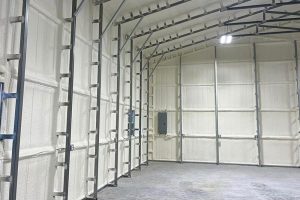
Interior walls — new construction & additions
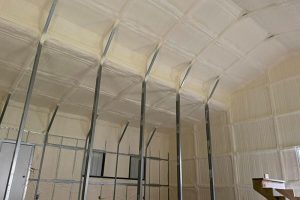
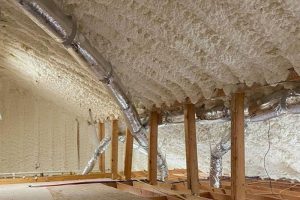
Interior ceilings — sound separation between floors
Light commercial interiors
Rim joists & band boards

Recent open-cell spray foam projects in North Houston & East Texas
Real installs across the region — pulled directly from our project archive by service type. Every job linked to the full project page with photos and details.
Sorry, we couldn't find any posts. Please try a different search.
Why North Houston property owners choose Weeks Spray Foam for open-cell insulation
Weeks Spray Foam is a fully licensed spray foam contractor serving residential and commercial customers throughout North Houston and East Texas. We regularly work on new builds, additions, and retrofits across Conroe, Livingston, Cleveland, Huntsville, Liberty, Coldspring, and the surrounding region. We’re not a national franchise — we’re a local crew that shows up on time, does the job right, and leaves your property clean.
Licensed & Insured Spray Foam Contractor
Fully licensed for residential and commercial spray foam work throughout Texas
Free estimates, No Pressure
A straight answer and a fair price on every project, no obligation
Proper Equipment, Proper Mix Ratios
We use properly calibrated equipment on every job and won't spray in conditions that compromise the product.
100+ Five-Star Reviews
Trusted by property owners across North Houston and East Texas for years
What customers say about our closed-cell spray foam installations
EXCELLENT Based on 124 reviews
 Posted on Google
 Jimmie JonesThey did a great job good price . Thank youPosted on Google
 Steven StruthersAustin and his crew did a great job on our little barndo guest house! We will definitely use them for future projects.Posted on Google
 Adys MirabalHands down best in town! Very responsive, great price and great and quick work I would call them and refer my friends!Posted on Google
 John BenckensteinGreat work, would recommendPosted on Google
 EddieDid a great job insulating an add on at our Church "Hillister Assembly of God". I would definitely recommend them.Posted on Google
 Jennifer WellsI can’t say enough great things about Weeks Spray Foam! From the very first phone call to the final walkthrough, their team was professional, knowledgeable, and genuinely committed to doing the job right. They took the time to explain the entire process, answered all of my questions, and made sure I felt confident every step of the way. The quality of their work is outstanding — clean, precise, and completed on schedule. You can tell they take real pride in what they do. On top of that, their customer service is second to none. Friendly, responsive, and reliable — exactly what you hope for when hiring a contractor. If you’re looking for spray foam insulation done right, I highly recommend Weeks Spray Foam. You won’t be disappointed!Posted on Google
 bowman reynoldsWe absolutely love these guys! They spray all of our new builds great customer service short lead times and fast quality workPosted on Google
 Josh FulcherAfter being screwed around by another spray foam company, I reached out to Weeks and BOOM, 100% professional service, great quality of work and clean up, along with best in class customer service and price! Will certainly have them out again, for my next project!
A straightforward way to get the job done
A strong fit for projects that need complete cavity fill, real air sealing, and sound control at a price that makes sense for interior residential and light commercial work.
-
Request a Quote
Tell us about the building, the project type, and where the property is located. -
Review the Job
We look at the scope, building type, and insulation needs so we can recommend the right solution. -
Schedule the Work
We coordinate timing and keep the project moving as efficiently as possible. -
Install the Spray Foam
Our crew completes the work with a focus on quality, consistency, and long-term performance. -
Enjoy a Better-Performing Building
You get a tighter, more comfortable, more energy-efficient space built for Texas conditions.
How much does spray foam cost in Conroe, TX?
Open-cell spray foam typically runs $0.25–$1.00 per board foot installed — significantly less than closed-cell, which makes it the right call for cost-sensitive interior applications like wall cavities and attic rooflines.
A standard 2,400 sq ft residential new build insulated with open-cell in the walls and attic roofline typically runs $4,500–$8,500 depending on thickness and accessibility. We look at your building and give you a firm number — not a ballpark.
Building size
Single story vs. multi-level
Interior walls vs. attic roofline
Accessibility conditions
New construction vs. retrofit
Square footage and cavity depth
Open-cell spray foam service areas — North Houston, East Texas & the Lake Livingston region
We install open-cell spray foam insulation throughout North Houston and East Texas. Not sure if we cover your area? Call us at (936) 433-7046.
Open-cell spray foam FAQs — cost, performance & Texas applications
Is open-cell spray foam a good choice for Texas's humidity?
It depends on where it's being applied. Open-cell foam is vapor-permeable, which makes it less ideal for exterior assemblies or crawl spaces in East Texas's humid environment. For interior walls and conditioned attic rooflines, it performs well. For metal buildings, exterior walls, and crawl spaces where moisture management is critical, closed-cell is the better product for this climate. We'll tell you which is right for your specific application when we come out for the estimate.
Can open-cell spray foam get wet?
Open-cell foam will absorb water if directly exposed, which is why it's not appropriate for applications where bulk water intrusion is possible. It should not be used in crawl spaces with moisture problems, on exterior-facing surfaces, or in any assembly where liquid water could reach the foam. For those applications, closed-cell is the correct product. If open-cell gets wet from a plumbing leak or roof failure, it needs to dry completely and should be inspected before drywall is re-installed.
Does open-cell spray foam provide a good air seal?
Yes — air sealing is one of open-cell spray foam's primary strengths. It outperforms fiberglass batts significantly on air leakage because it fills every gap and cavity completely rather than sitting loosely between framing members. The air seal is often what drives the energy efficiency gains more than the R-value number itself.
Can open-cell spray foam be left exposed?
No. Like all spray polyurethane foam, open-cell must be covered by an ignition barrier or thermal barrier — typically drywall — in occupied spaces per Texas building code. We confirm the code requirement for every project before we spray and will advise on what's required for your specific application.
How long does open-cell spray foam last?
Properly installed open-cell spray foam has an indefinite service life under normal conditions. It doesn't compress, settle, or lose R-value over time the way fiberglass batts do. As long as it stays dry and isn't physically disturbed, it performs the same in year 25 as it did in year one.
What's the difference in R-value between open-cell and closed-cell?
Open-cell achieves approximately R-3.5 to R-3.8 per inch. Closed-cell achieves R-6 to R-7 per inch. For a 2×4 wall cavity (3.5 inches deep), open-cell spray foam delivers roughly R-13 — meeting or exceeding code minimum for most Texas wall assemblies. For applications requiring higher R-values in thinner profiles, or anywhere moisture barrier properties are needed, closed-cell is the better option.
Is open-cell spray foam worth it over fiberglass batts?
For most new construction and addition projects — yes. Open-cell costs more per square foot than fiberglass batts but provides a genuine air seal, complete cavity fill with no voids, and meaningful sound attenuation that batts can't match. The energy performance difference is consistent and real, and the comfort improvement is immediate.
How much does open-cell spray foam cost in Texas?
Open-cell spray foam typically runs $0.44–$0.65 per board foot installed depending on thickness, building type, and accessibility — significantly less than closed-cell. For a full residential new build, most jobs fall in the $4,500–$8,500 range. We don't give ballpark numbers on the phone — after a site visit we give you a firm written estimate because every job is different. Call (936) 433-7046 or fill out the form above for a free estimate.
Related Insulation Services
- Closed-Cell Spray Foam
- Attic Spray Foam
- Garage Insulation
- Crawl Space Insulation