
Garage Insulation
Spray Foam Garage Insulation in North Houston & East Texas
An uninsulated attached garage is the reason the bedroom above it is always the hottest room in the house. We fix the source — not the symptom.
Get A Free Estimate
The two garage insulation problems — heat transfer into your home vs. conditioning your own workspace
Most garage insulation calls we get come from one of two situations.
The first is a homeowner with an attached garage who’s tired of the bedroom above the garage being 10°F hotter than the rest of the house in summer — or the utility room adjacent to the garage running warm no matter what the thermostat is set to. The problem is heat transfer through the shared wall and ceiling between the garage and the living space. The fix is insulating those shared surfaces, not the whole garage.
The second situation is a property owner who wants to use their garage as a workshop, man cave, gym, or extra conditioned space — and wants to do it without running an HVAC unit that fights an uninsulated building all day. For this, the full exterior envelope of the garage needs to be foamed before adding conditioning makes financial sense.
These are different scopes, different surface areas, and different price points. We assess which situation you’re in before scoping anything.
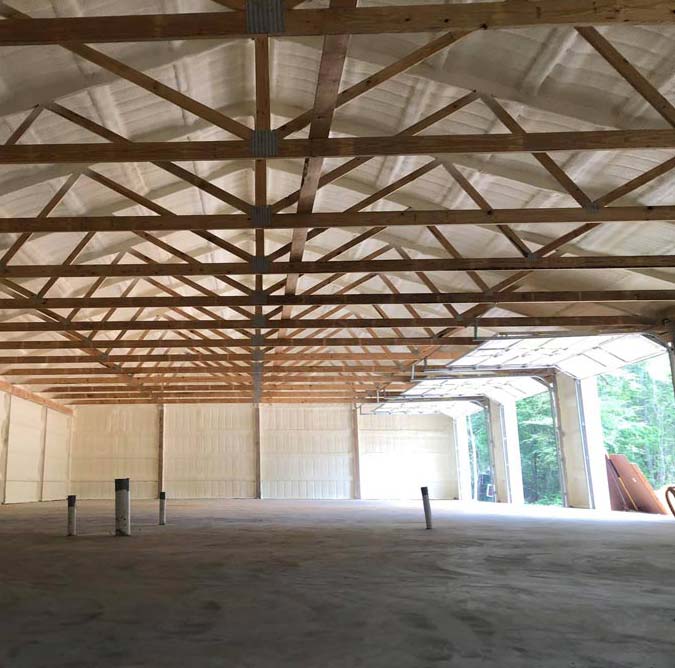
Multiple Door Metal Garage Spray Foam Insulation in Liberty, TX
What open-cell spray foam does that fiberglass and batts can't
An attached garage in North Houston or East Texas doesn’t stay outside — it shares walls and ceilings with your living space and pushes heat and humidity into your home all summer. Spray foam on the shared surfaces stops the transfer at the source, before it reaches the room above or the HVAC bill.
Eliminates the Hot Bedroom Above the Garage
The ceiling between a garage and the living space above it is a direct thermal conduit — a 120°F garage heats the floor above it all day. Closed-cell foam on the garage side of that ceiling breaks the thermal path and measurably lowers peak temperature in the room above.
Stops the Heat Bleed into Adjacent Living Spaces
Every wall shared between a garage and a conditioned living space — the laundry room, the mudroom, the hallway — conducts heat from the garage into the home. Foam on the garage side of those shared walls stops the bleed where it originates.
Makes the Garage Usable in Summer
A garage attached to a home that's shedding heat into the living space forces the HVAC system to work harder than the home's square footage would suggest. Insulating the shared surfaces reduces that parasitic load.
Half the Cost of Closed-Cell
Even without adding a mini split, a properly insulated garage is significantly more usable in Texas summer than an uninsulated one — peak temperatures drop 20–30°F and the space becomes workable for multiple additional hours per day.
Prepares the Envelope for Conditioning
If you want to add a mini split and cool or heat the garage, the insulation has to come first. A mini split in an uninsulated garage runs constantly, can't keep up on hot days, and is sized for a load that will be much lower once the envelope is tight.
Controls Humidity in the Garage
Garages in East Texas accumulate humidity that rusts tools, swells stored wood, and grows mold in stored items. Closed-cell foam on the exterior walls and ceiling creates a vapor barrier that reduces the moisture infiltration causing those problems.
Spray foam vs. fiberglass vs. rigid board for garage insulation
Homeowners in North Houston and East Texas frequently attempt garage insulation with fiberglass batts purchased from a home center. Here is why that approach underperforms and what the difference is with spray foam.
| Feature | Closed-Cell Spray Foam | Fiberglass Batts (DIY) | Rigid Foam Board |
|---|---|---|---|
| Air sealing | Yes — monolithic | No — significant gaps at edges | Partial — seams and edges leak |
| Vapor control | Yes — Class II retarder | No | Yes, but seams fail over time |
| R-value per inch | R-6 to R-7 | R-3.2 to R-3.8 | R-3.8 to R-6.5 |
| Works on irregular surfaces | Yes — conforms to any shape | No — falls out of irregular bays | No — rigid panels only |
| Covers penetrations and openings | Yes — foam fills gaps | No | No — requires separate sealant |
| Lasts without re-doing | Yes — permanent installation | No — falls, compresses, absorbs moisture | Partial — seams loosen over time |
Want more detail? → Is spray foam worth it in Texas? · Open-cell vs. closed-cell — full breakdown
How we insulate attached garages vs. detached garages — the approach is different
The insulation priority differs based on whether the garage is attached to the home or freestanding. Here is how we approach each situation.
Attached Garage — shared boundary priority
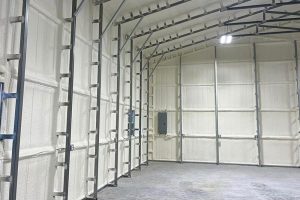
Shared wall between garage and living space
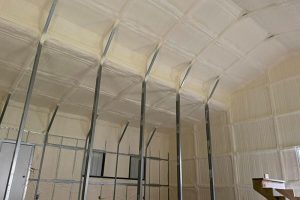
Garage ceiling under living space above
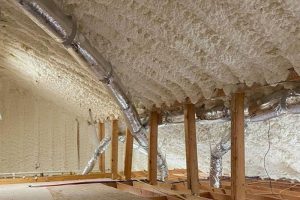
Garage door wall and rough openings
Detached Garage — full envelope for conditioning
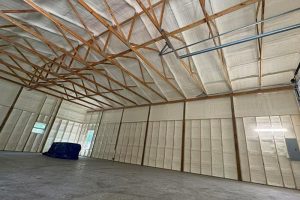
Exterior walls — full envelope for a conditioned workspace
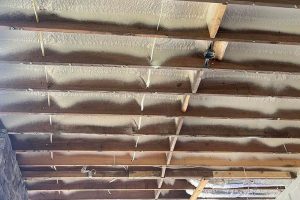
Ceiling or roofline of detached garage

Garage door and rough openings on detached structures
Recent garage insulation jobs across North Houston and East Texas
A sample of attached and detached garages we’ve insulated — from shared-wall priorities in suburban homes to full envelope conditioning in detached workshops across the region.
Sorry, we couldn't find any posts. Please try a different search.
Why North Houston homeowners choose Weeks for garage insulation
Garage insulation is one of the fastest payback spray foam jobs in our book — particularly the shared ceiling between a garage and a bedroom above. The before-and-after temperature difference in that room is often immediately noticeable. We scope the right surfaces for your situation and don’t oversell the full envelope when the shared boundary is all you need.
We Scope the Right Problem
We assess whether you need shared-boundary insulation or full envelope conditioning before we write any estimate. These are different scopes and different prices — you'll know which one you need before we start.
Licensed & Insured Spray Foam Contractor
Fully licensed for residential spray foam work throughout Texas.
Free Estimates, No Pressure
Site visit, assessment, firm written estimate — no ballparks and no obligation.
100+ Five-Star Reviews
Trusted by homeowners across North Houston and East Texas for insulation that solves the problem the first time.
What customers say about our garage spray foam installations
EXCELLENT Based on 124 reviews
 Posted on Google
 Jimmie JonesThey did a great job good price . Thank youPosted on Google
 Steven StruthersAustin and his crew did a great job on our little barndo guest house! We will definitely use them for future projects.Posted on Google
 Adys MirabalHands down best in town! Very responsive, great price and great and quick work I would call them and refer my friends!Posted on Google
 John BenckensteinGreat work, would recommendPosted on Google
 EddieDid a great job insulating an add on at our Church "Hillister Assembly of God". I would definitely recommend them.Posted on Google
 Jennifer WellsI can’t say enough great things about Weeks Spray Foam! From the very first phone call to the final walkthrough, their team was professional, knowledgeable, and genuinely committed to doing the job right. They took the time to explain the entire process, answered all of my questions, and made sure I felt confident every step of the way. The quality of their work is outstanding — clean, precise, and completed on schedule. You can tell they take real pride in what they do. On top of that, their customer service is second to none. Friendly, responsive, and reliable — exactly what you hope for when hiring a contractor. If you’re looking for spray foam insulation done right, I highly recommend Weeks Spray Foam. You won’t be disappointed!Posted on Google
 bowman reynoldsWe absolutely love these guys! They spray all of our new builds great customer service short lead times and fast quality workPosted on Google
 Josh FulcherAfter being screwed around by another spray foam company, I reached out to Weeks and BOOM, 100% professional service, great quality of work and clean up, along with best in class customer service and price! Will certainly have them out again, for my next project!
A straightforward way to get the job done
Garage insulation jobs are typically scoped and priced in a single site visit. Shared-boundary installs on an attached garage are often completed in half a day. Full envelope installs on a detached garage typically take one full day.
-
Request a Quote
Tell us about the building, the project type, and where the property is located. -
Review the Job
We look at the scope, building type, and insulation needs so we can recommend the right solution. -
Schedule the Work
We coordinate timing and keep the project moving as efficiently as possible. -
Install the Spray Foam
Our crew completes the work with a focus on quality, consistency, and long-term performance. -
Enjoy a Better-Performing Building
You get a tighter, more comfortable, more energy-efficient space built for Texas conditions.
How much does garage insulation cost in North Houston?
Shared-boundary insulation on a standard attached two-car garage — the shared wall and ceiling only — typically runs $1,500–$4,000. Full envelope foam on a detached garage sized for conditioning typically runs $4,000–$9,000 depending on building size and wall height. These are meaningfully different scopes, so getting the right assessment first determines which range applies to your situation.
A standard 2,400 sq ft residential new build insulated with open-cell in the walls and attic roofline typically runs $4,500–$8,500 depending on thickness and accessibility. We look at your building and give you a firm number — not a ballpark.
Attached vs. detached garage
Shared boundary only vs. full envelope
Garage square footage
Ceiling height
Detached: intended use (workshop, conditioned space)
Mini split coordination (if applicable)
Garage insulation service areas — North Houston, East Texas & the Lake Livingston region
We insulate garages throughout North Houston and East Texas. Not sure if we cover your area? Call (936) 433-7046.
Garage insulation FAQs — attached garages, detached workshops & North Houston homes
Should I insulate my entire garage or just the shared wall with my house?
It depends on what problem you're solving. If your goal is stopping heat transfer into the adjacent living space — fixing the hot bedroom above the garage or the warm laundry room next to it — you need the shared surfaces: the wall and/or the ceiling between the garage and your home. If you want to condition and use the garage as a workspace, the full exterior envelope needs to be insulated. We assess the situation during the site visit and recommend the right scope before we quote anything.
Will insulating my garage lower the temperature in the room above it?
Yes — measurably. Homeowners with bedrooms or finished spaces above attached garages commonly see 5–15°F reductions in peak summer temperature in those rooms after spray foam on the garage ceiling. The result depends on how well the rest of that room's envelope is insulated, but the garage ceiling is almost always the largest contributing source of heat in those spaces.
Does spray foam go on the interior or exterior of the garage walls?
Interior — spray foam is applied to the interior face of the wall framing or the garage side of the shared wall surface. We work from inside the garage on all surfaces, which means no exterior disruption and no exterior access required.
My garage walls are already drywalled. Can spray foam still be added?
If the wall framing is already enclosed with drywall, accessing the cavity for spray foam requires opening the wall. For shared walls between a garage and a living space, that's sometimes worth doing depending on the severity of the heat problem. In other cases, rigid foam board against the existing drywall with a new drywall face is a reasonable alternative. We assess the specific situation and advise on the most cost-effective approach.
What mini split size do I need for a conditioned garage?
That depends on the insulation — which is why we always recommend insulating before sizing HVAC. An uninsulated 500 sq ft garage might need a 2-ton system. That same garage properly insulated with closed-cell foam typically needs a 3/4-ton to 1-ton unit. We can advise on sizing after the insulation is scoped.