
Shop Insulation
Spray Foam Shop Insulation in North Houston & East Texas
An uninsulated metal shop is a condensation problem, a heat problem, and a tool-damage problem. Closed-cell spray foam solves all three in a single application — and it’s the only product that actually does.
Get A Free Estimate
What an uninsulated metal shop actually does to your tools, equipment, and structure
In East Texas and North Houston, a metal shop without proper insulation runs two predictable failure cycles: summer heat and morning condensation. The heat is obvious — by midday in July, an uninsulated shop is 120–130°F inside. What shop owners underestimate is the condensation damage.
On cool nights, the metal panels drop to near ambient temperature. When warm humid air hits those panels in the morning, moisture condenses on every metal surface — walls, roof deck, equipment, tools. That daily moisture cycle is what causes rust on equipment racks, corrosion on hand tools, mold on stored materials, and eventually structural rust in the building framing itself.
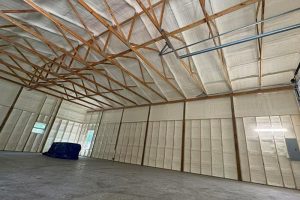
Closed-cell spray foam bonds directly to the metal skin of every panel and cures into a Class II vapor retarder — physically preventing warm humid air from ever reaching the metal surface. No contact with the metal, no condensation. The same application that stops the moisture problem also provides R-value that keeps the shop from becoming a 130°F oven in the afternoon. Both problems, one product, one visit.
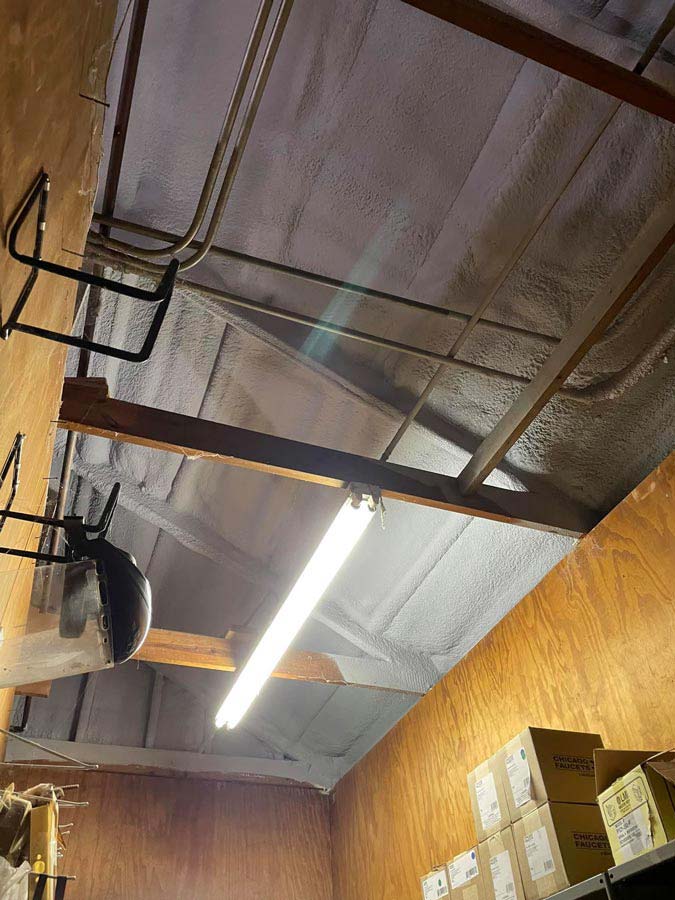
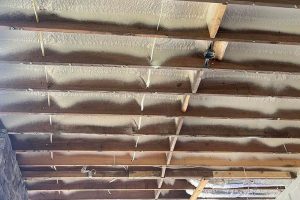
Ceiling spray foam installation in a workshop in Livingston, TX.
What open-cell spray foam does that fiberglass and batts can't
Metal shops in North Houston and East Texas have two problems that conventional insulation doesn’t solve: condensation that corrodes everything inside, and heat that shuts down productivity for half the summer. Closed-cell spray foam addresses both at the shell — before they reach your tools, your equipment, or your workday.
Eliminates Morning Condensation Permanently
Closed-cell foam bonds to every panel surface and acts as a continuous vapor retarder — warm humid air never reaches the metal. No more drip from the ceiling, no more moisture on the floor, no more rust forming on equipment left overnight.
Protects Tools and Equipment
Condensation is what destroys tool storage, rusts drill bits, corrodes motors, and degrades electronics in a shop. Eliminating condensation at the source protects every piece of equipment in the building — not just what's on the shelf today but what you add over the building's lifetime.
Extends Usable Working Hours in Summer
A well-insulated shop is 20–40°F cooler than an uninsulated one at peak afternoon heat. That difference determines whether you can comfortably work through the afternoon or have to stop at noon from June through September.
Stops Structural Rust in Its Tracks
Metal buildings that have been condensating for years develop rust at the base of wall panels, at purlin connections, and at roofline fasteners. Stopping the moisture cycle stops further deterioration. Spray foam doesn't reverse existing rust, but it prevents the progression.
One Product Handles the Entire Shell
Because closed-cell foam covers rooflines, walls, gable ends, and penetrations in the same application, there's no assembly of multiple products with gaps between them. The building envelope is sealed and insulated in a single pass.
Ready for a Mini Split When You Are
An insulated shop sized correctly with a mini split becomes a fully conditioned year-round workspace. The foam reduces the heat load so drastically that a much smaller HVAC unit achieves comfortable conditioning. Get the envelope right first, then size the HVAC correctly for the actual load.
Closed-cell spray foam vs. the alternatives for metal shop insulation
Shop owners in North Houston and East Texas have tried fiberglass, radiant barriers, and rigid foam board in metal shops. Here is why those products fail to solve the actual problems — and what closed-cell spray foam does differently.
| Feature | Closed-Cell Spray Foam | Fiberglass Batts | Radiant Barrier | Rigid Foam Board |
|---|---|---|---|---|
| Stops condensation | Yes — bonded to metal | No — gap behind batt allows condensation | No | No — seams allow infiltration |
| R-value per inch | R-6 to R-7 | R-3.2 to R-3.8 | None (reflects radiant only) | R-3.8 to R-6.5 |
| Continuous vapor retarder | Yes — Class II | No | No | Partial — seams fail |
| Protects tools from moisture | Yes | No | No | No |
| Works on gable ends and curves | Yes — conforms to any surface | Difficult to fit | No | No — rigid, can't conform |
| Ready for HVAC / mini split | Yes — correct envelope for sizing | No — envelope still leaky | No | Partially |
Want more detail? → Is spray foam worth it in Texas? · Open-cell vs. closed-cell — full breakdown
Every surface of a metal shop we insulate with closed-cell spray foam
A complete shop envelope means every surface — roof, walls, gable ends, door openings, and any interior partitions. Leaving any one of them unfoamed gives condensation and heat a place to re-enter. We scope the full shell, not just the easy surfaces.
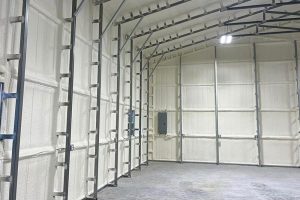
Roof panels — highest priority
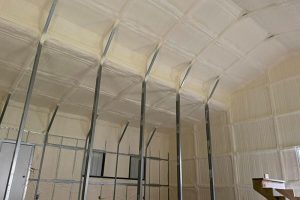
Exterior wall panels
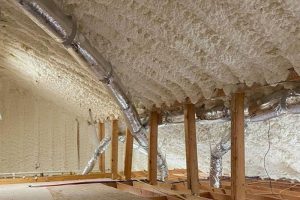
Gable ends and ridge areas
Bay door surrounds and rough openings
Interior office and partition walls

Skylights and roof penetrations
Recent shop insulation jobs across North Houston and East Texas
A sample of metal shops we’ve insulated — pole barns, commercial bays, and personal workshops across the region.
Sorry, we couldn't find any posts. Please try a different search.
Why North Houston and East Texas shop owners choose Weeks Spray Foam
We Know Metal Buildings
Steel construction has specific requirements for insulation — purlin depth, panel type, vapor management, and correct sequencing. We understand all of it and spec each job accordingly.
Licensed & Insured Spray Foam Contractor
Fully licensed for commercial and residential spray foam work throughout Texas. Every shop job is properly insured.
Free Estimates, No Pressure
We visit your shop, assess the structure, and give you a firm written estimate. No phone-call ballparks.
100+ Five-Star Reviews
Trusted by shop owners, builders, and property owners across North Houston and East Texas.
What shop owners say about Weeks Spray Foam
EXCELLENT Based on 124 reviews
 Posted on Google
 Jimmie JonesThey did a great job good price . Thank youPosted on Google
 Steven StruthersAustin and his crew did a great job on our little barndo guest house! We will definitely use them for future projects.Posted on Google
 Adys MirabalHands down best in town! Very responsive, great price and great and quick work I would call them and refer my friends!Posted on Google
 John BenckensteinGreat work, would recommendPosted on Google
 EddieDid a great job insulating an add on at our Church "Hillister Assembly of God". I would definitely recommend them.Posted on Google
 Jennifer WellsI can’t say enough great things about Weeks Spray Foam! From the very first phone call to the final walkthrough, their team was professional, knowledgeable, and genuinely committed to doing the job right. They took the time to explain the entire process, answered all of my questions, and made sure I felt confident every step of the way. The quality of their work is outstanding — clean, precise, and completed on schedule. You can tell they take real pride in what they do. On top of that, their customer service is second to none. Friendly, responsive, and reliable — exactly what you hope for when hiring a contractor. If you’re looking for spray foam insulation done right, I highly recommend Weeks Spray Foam. You won’t be disappointed!Posted on Google
 bowman reynoldsWe absolutely love these guys! They spray all of our new builds great customer service short lead times and fast quality workPosted on Google
 Josh FulcherAfter being screwed around by another spray foam company, I reached out to Weeks and BOOM, 100% professional service, great quality of work and clean up, along with best in class customer service and price! Will certainly have them out again, for my next project!
A straightforward way to get the job done
Shop insulation jobs are typically scoped in a single site visit and completed in one to two days depending on building size. No special prep is required beyond clearing the area of equipment or inventory that can’t be moved — we work around what’s there.
-
Request a Quote
Tell us about the building, the project type, and where the property is located. -
Review the Job
We look at the scope, building type, and insulation needs so we can recommend the right solution. -
Schedule the Work
We coordinate timing and keep the project moving as efficiently as possible. -
Install the Spray Foam
Our crew completes the work with a focus on quality, consistency, and long-term performance. -
Enjoy a Better-Performing Building
You get a tighter, more comfortable, more energy-efficient space built for Texas conditions.
How much does spray foam shop insulation cost in North Houston?
Closed-cell spray foam for metal shops typically runs $1.50–$3.00 per board foot. A standard 40×60 metal shop insulated at 2 inches on the roof panels and walls typically falls in the $7,000–$14,000 range. Larger shops and thicker applications run higher. We measure the actual surface area on site and give you a real number — not an estimate from square footage alone.
Building size (sq ft of surface, not floor)
Roof-only vs. full building
Required thickness for condensation control
Wall height and access conditions
Bay door count and configuration
Office or partition scope
Shop insulation service areas — North Houston, East Texas & the Lake Livingston region
We insulate metal shops throughout North Houston and East Texas — from Conroe and Huntsville to Livingston, Cleveland, Coldspring, Trinity, and the surrounding communities where shops and working buildings are most common. Not sure if we reach your area? Call (936) 433-7046.
Shop insulation FAQs — condensation, cost & spray foam in Texas shops
Why does my metal shop have so much condensation and can spray foam actually fix it?
Condensation forms when warm humid East Texas air contacts a metal surface that's cooled below the dew point — which happens every morning in the cooler months and on summer nights when the building has aired out. Closed-cell spray foam bonds directly to every metal surface and acts as a continuous vapor retarder — warm humid air physically cannot reach the metal. Condensation stops completely in properly insulated assemblies.
Do I have to insulate the whole shop or can I just do the roof?
Roof-only is a common starting point and the highest-impact single surface. But if condensation on the walls is also causing problems — which it usually is — partial coverage just moves the moisture to the un-foamed sections. We scope what you actually need rather than selling you more or less than the job requires.
Do I need to insulate a shop if I'm not planning to heat or cool it?
Yes — for condensation prevention alone, insulation is worth it regardless of whether you ever add HVAC. Foam stops the morning drip and the daily moisture cycle that destroys tools and corrodes the structure. Many shop owners foam first and add a mini split later once the envelope is sealed and they can size the HVAC correctly for the actual load.
Can spray foam be left exposed in a shop or does it need to be covered?
In a working shop classified as a non-occupied structure, spray foam can often be left exposed. If the shop has a finished area or is classified as occupied, a thermal barrier is required — typically intumescent coating rather than drywall in a working environment. We advise on what's required for your specific building during the estimate.
How long does a shop insulation installation take?
Most shop insulation projects are completed in one day. Larger buildings — 60×100 and up — may take two days. We give you a specific timeline with the written estimate.