
Residential Spray Foam Insulation
Residential Spray Foam Insulation for North Houston & East Texas Homes
Whether you’re building new or retrofitting an existing home, spray foam insulation delivers the energy efficiency, moisture control, and indoor comfort that fiberglass simply cannot in Texas.
Get A Free Estimate
Why North Houston and East Texas homeowners are switching from fiberglass to spray foam
Texas homes face a specific combination of conditions that fiberglass insulation was never designed for: sustained summer heat above 95°F, high relative humidity pushing moisture into the building envelope, and an energy grid where inefficiency shows up directly on the electric bill every month.
Fiberglass fills the cavity. It doesn’t air-seal it, doesn’t vapor-manage it, and doesn’t stop the hot attic from driving heat through your ceiling. Spray foam does all three simultaneously. Closed-cell foam on the building envelope — exterior walls, attic roofline, crawl space walls — creates a genuinely tight thermal shell that dramatically reduces HVAC load and produces consistent room temperature throughout the house.
Most homes in North Houston and East Texas that upgrade to spray foam from blown-in or fiberglass see measurable reductions in monthly energy bills and consistent temperatures in rooms that were always too hot or too cold. The attic — which is typically the highest-impact location — sees the most dramatic change.
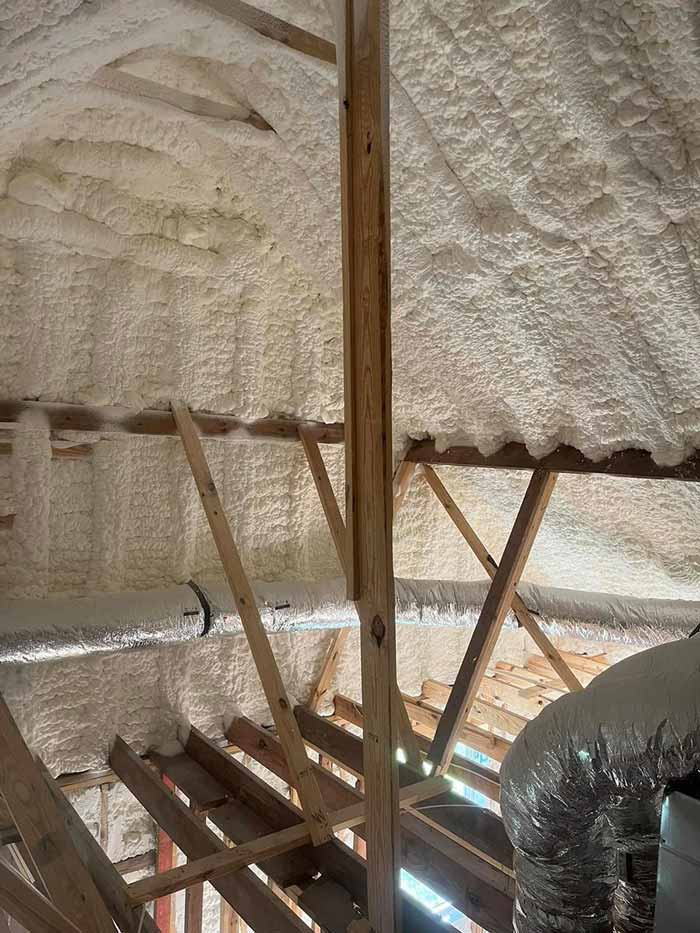
Residential Open-cell spray foam insulation in Houston, TX
Six ways spray foam improves life in a North Houston or East Texas home
North Houston and East Texas homes deal with heat, humidity, and energy bills that expose every weakness in a fiberglass insulation system. Spray foam addresses what fiberglass can’t — air infiltration, moisture movement, and the hot and cold zones that make rooms uncomfortable. Here’s why more homeowners in Climate Zone 2 are choosing it.
Consistent Temperature Room to Room
Fiberglass insulation manages R-value but not air movement — hot and cold zones persist because conditioned air is still escaping and outdoor air is still infiltrating. Spray foam eliminates both, producing consistent temperature throughout the house.
Lower Monthly Energy Bills
Properly sealed homes with spray foam consistently see 20–40% reductions in HVAC energy consumption compared to fiberglass-insulated homes of the same size. The savings come from both lower HVAC load and increased system efficiency when it's not fighting infiltration.
Real Humidity Control
North Houston and East Texas humidity doesn't stop at your walls. Vapor-permeable insulation like fiberglass lets moisture move through the envelope, which your HVAC has to remove. Closed-cell foam's Class II vapor retarder rating stops moisture at the wall — reducing dehumidification load and improving indoor air quality.
Quieter Interior
Spray foam — particularly open-cell in interior walls — provides significantly better sound attenuation than fiberglass. Street noise, rain on the roof, and room-to-room sound transmission all improve noticeably.
No Settling, No Re-Insulation
Blown-in fiberglass and cellulose settle over time, losing R-value and leaving gaps. Spray foam is permanent — it maintains its R-value, its air seal, and its vapor barrier performance for the life of the structure.
Better Indoor Air Quality
A tighter building envelope means less outdoor air infiltration — which means less pollen, humidity, and outdoor particulate moving through gaps and into your living space. Spray foam contributes meaningfully to IAQ improvement alongside proper ventilation.
Residential spray foam vs. blown-in fiberglass vs. fiberglass batts in a Texas home
Most North Houston and East Texas homeowners start the insulation conversation comparing these three products. Here is an honest side-by-side on what matters for Texas residential performance.
| Feature | Closed-Cell Spray Foam | Blown-In Fiberglass | Fiberglass Batts |
|---|---|---|---|
| Air sealing | Yes — monolithic barrier | No — requires separate sealing | No |
| Vapor control | Yes — Class II retarder | No | No |
| R-value per inch | R-6 to R-7 | R-2.5 to R-3.7 | R-3.2 to R-3.8 |
| Settles over time | No — permanent | Yes — 10–20% loss | Yes — compresses |
| Works for attic roofline | Yes — conditioned attic | Attic floor only | No |
| Works for crawl spaces | Yes | No — falls and absorbs moisture | No — sagging, moisture risk |
| Upfront cost | Higher | Lower | Lowest |
Want more detail? → Is spray foam worth it in Texas? · Open-cell vs. closed-cell — full breakdown
Where we install residential spray foam — new builds and existing homes
The approach differs between new construction and existing home retrofit. New builds allow full access to all framing before walls close. Retrofits focus on the highest-impact accessible locations — typically the attic first, then crawl spaces and rim joists.
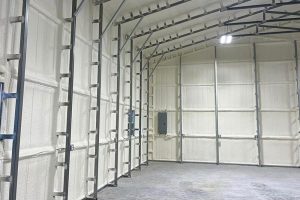
New construction — exterior wall cavities
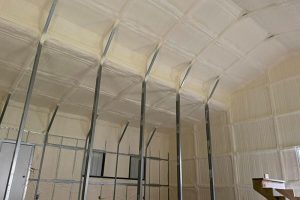
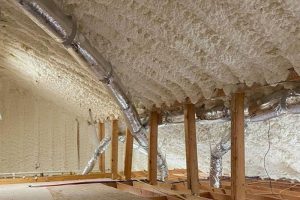
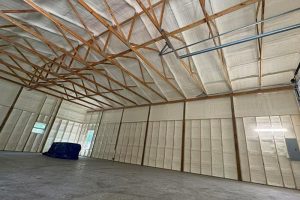
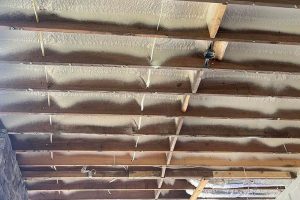

Knee walls, bonus rooms, and hard-to-reach areas
Recent open-cell spray foam projects in North Houston & East Texas
Real installs across the region — pulled directly from our project archive by service type. Every job linked to the full project page with photos and details.
Sorry, we couldn't find any posts. Please try a different search.
Why North Houston and East Texas homeowners choose Weeks for residential spray foam
Residential spray foam is a precision product. Wrong mix ratio, wrong thickness, or wrong product for the assembly creates problems that are expensive to fix after drywall goes up. Weeks uses calibrated equipment, the right product for each assembly, and doesn’t cut corners on thickness or coverage.
Right Product for the Right Location
Closed-cell where moisture and vapor control matter. Open-cell where sound control and cavity fill are the goal. We recommend and install the product matched to each specific assembly — not whatever's on the truck.
Licensed & Insured Spray Foam Contractor
Fully licensed for residential spray foam work throughout Texas. Every install is insured and every job site is left clean.
Free Estimates, No Pressure
We assess your home or plans, scope each assembly, and give you a firm written estimate. No ballpark ranges, no pressure.
100+ Five-Star Reviews
Trusted by homeowners and builders across North Houston and East Texas.
What North Houston homeowners say about our residential spray foam installations
EXCELLENT Based on 124 reviews
 Posted on Google
 Jimmie JonesThey did a great job good price . Thank youPosted on Google
 Steven StruthersAustin and his crew did a great job on our little barndo guest house! We will definitely use them for future projects.Posted on Google
 Adys MirabalHands down best in town! Very responsive, great price and great and quick work I would call them and refer my friends!Posted on Google
 John BenckensteinGreat work, would recommendPosted on Google
 EddieDid a great job insulating an add on at our Church "Hillister Assembly of God". I would definitely recommend them.Posted on Google
 Jennifer WellsI can’t say enough great things about Weeks Spray Foam! From the very first phone call to the final walkthrough, their team was professional, knowledgeable, and genuinely committed to doing the job right. They took the time to explain the entire process, answered all of my questions, and made sure I felt confident every step of the way. The quality of their work is outstanding — clean, precise, and completed on schedule. You can tell they take real pride in what they do. On top of that, their customer service is second to none. Friendly, responsive, and reliable — exactly what you hope for when hiring a contractor. If you’re looking for spray foam insulation done right, I highly recommend Weeks Spray Foam. You won’t be disappointed!Posted on Google
 bowman reynoldsWe absolutely love these guys! They spray all of our new builds great customer service short lead times and fast quality workPosted on Google
 Josh FulcherAfter being screwed around by another spray foam company, I reached out to Weeks and BOOM, 100% professional service, great quality of work and clean up, along with best in class customer service and price! Will certainly have them out again, for my next project!
A straightforward way to get the job done
Residential jobs are scoped at the home — we walk the structure, identify the assemblies, and recommend the right product and thickness for each location. New construction timing is coordinated with your builder’s schedule.
-
Request a Quote
Tell us about the building, the project type, and where the property is located. -
Review the Job
We look at the scope, building type, and insulation needs so we can recommend the right solution. -
Schedule the Work
We coordinate timing and keep the project moving as efficiently as possible. -
Install the Spray Foam
Our crew completes the work with a focus on quality, consistency, and long-term performance. -
Enjoy a Better-Performing Building
You get a tighter, more comfortable, more energy-efficient space built for Texas conditions.
How much does residential spray foam insulation cost in North Houston?
Residential closed-cell spray foam typically runs $1.50–$3.00 per board foot. Open-cell runs $0.44–$0.65 per board foot. A new construction home insulated with closed-cell on exterior walls and the attic roofline typically falls in the $8,000–$16,000 range depending on square footage and access. Attic-only retrofits on existing homes commonly run $3,500–$8,500. We visit your home and give you a firm number.
New construction vs. existing home retrofit
Closed-cell vs. open-cell product
Total square footage and assembly count
Attic-only vs. full envelope
Number of stories and access conditions
Crawl space and rim joist scope
Residential spray foam service areas — North Houston, East Texas & the Lake Livingston region
We install residential spray foam throughout North Houston and East Texas — from Conroe and The Woodlands north through Huntsville and Livingston, and east through Cleveland, Coldspring, and the Lake Livingston communities. Not sure if we cover your area? Call (936) 433-7046.
Residential spray foam FAQs — cost, products & Texas homes
Is spray foam worth it for a Texas home compared to blown-in fiberglass?
For most North Houston and East Texas homeowners — yes, particularly for the attic. The key difference is that spray foam air-seals the envelope simultaneously with insulating it, while blown-in fiberglass only adds R-value. In a Texas climate where the attic reaches 150°F in summer, air sealing is what produces the measurable energy savings — and blown-in alone doesn't provide it.
Can spray foam be added to an existing home without tearing out walls?
Yes — the highest-impact retrofit locations don't require wall demolition. The attic (roofline application) and the crawl space are both accessible without opening walls. These two locations account for a majority of the air infiltration and heat gain in most existing homes. Full wall cavity retrofit is possible but less common — we assess whether it makes economic sense for your specific structure.
How much will residential spray foam reduce my energy bills?
Results vary by home, but homes that move from blown-in or fiberglass to spray foam commonly see 20–40% reductions in HVAC energy costs. The largest gains come from stopping air infiltration — which fiberglass never addressed — and moving HVAC equipment into conditioned attic space. We can give you a realistic expectation for your specific home during the estimate.
How long does a residential spray foam installation take?
New construction wall installs typically take one day for a standard single-story home. Attic roofline installs take four to eight hours depending on square footage and roofline complexity. Combined new construction envelope installs may take one to two days. We give you a specific timeline with the estimate.
Does the spray foam need to cure before we can re-enter the house?
Yes — closed-cell and open-cell spray foam require a ventilation period after application before re-entry. The standard recommendation is two to four hours with adequate ventilation. We will give you the specific re-entry time for your install based on the product and square footage applied.